
What is Digital Marketing? The Complete 2026 Guide
Published by Deegeet | Last updated: July 2026 | 12 min read
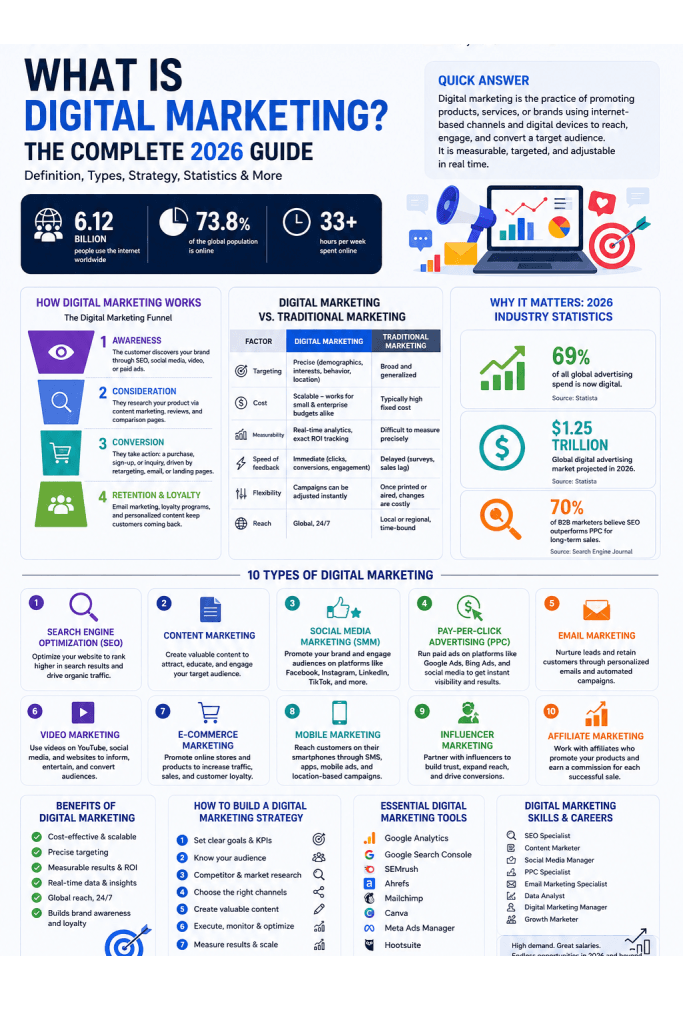
Quick answer: Digital marketing is the practice of promoting products, services, or brands using internet-based channels and digital devices including search engines, websites, social media, email, and paid ads to reach, engage, and convert a target audience. Unlike traditional marketing (TV, print, billboards), digital marketing is measurable, targeted, and adjustable in real time.
Below, Deegeet breaks down exactly what digital marketing means in 2026, the 10 core types every business should know, how it compares to traditional marketing, real industry data, and a practical framework for building a strategy that actually works.
Table of Contents
- What is Digital Marketing? (Definition)
- How Digital Marketing Works
- Digital Marketing vs. Traditional Marketing
- 10 Types of Digital Marketing
- Why Digital Marketing Matters: 2026 Industry Statistics
- Benefits of Digital Marketing
- How to Build a Digital Marketing Strategy (Step-by-Step)
- Essential Digital Marketing Tools
- Digital Marketing Skills & Careers
- Frequently Asked Questions
What is Digital Marketing? (Definition)
Digital marketing is any form of marketing that uses electronic devices or the internet to deliver promotional messages and measure their impact. It covers everything from a Google search ad to an Instagram Reel, a blog post optimized for SEO, or a personalized email flow.
At its core, digital marketing has three defining characteristics:
- Digital-first delivery: content and ads are distributed through websites, apps, search engines, and social platforms rather than physical media.
- Data and measurability: every click, impression, and conversion can be tracked in real time using tools like Google Analytics or Meta Ads Manager.
- Two-way interaction: audiences can comment, share, and respond, allowing brands to build relationships instead of broadcasting one-way messages.
In short: digital marketing is how modern businesses get found, get trusted, and get chosen: online, where 6.12 billion people, or roughly 73.8% of the global population, now spend an average of 33+ hours a week browsing the internet.
How Digital Marketing Works
Digital marketing typically follows the customer through four stages of a digital marketing funnel:
- Awareness: the customer discovers your brand through SEO, social media, video, or paid ads.
- Consideration: they research your product via content marketing, reviews, and comparison pages.
- Conversion: they take action: a purchase, sign-up, or inquiry, often driven by retargeting ads, email, or a strong landing page.
- Retention & Loyalty: email marketing, loyalty programs, and personalized content keep customers coming back.
Every channel below plays a role in one or more of these stages.
Digital Marketing vs. Traditional Marketing
| Factor | Digital Marketing | Traditional Marketing |
|---|---|---|
| Targeting | Precise (by demographics, interests, behavior, location) | Broad and generalized |
| Cost | Scalable works for small budgets and enterprise budgets alike | Typically high fixed cost (TV, print, billboards) |
| Measurability | Real-time analytics, exact ROI tracking | Difficult to measure precisely |
| Speed of feedback | Immediate (clicks, conversions, engagement) | Delayed (surveys, sales lag) |
| Flexibility | Campaigns can be adjusted instantly | Once printed or aired, changes are costly |
| Reach | Global, 24/7 | Local or regional, time-bound |
This is a major reason 69% of all global advertising spend is now digital, according to Statista, and the global digital advertising market is projected to reach roughly $1.25 trillion in 2026.
10 Types of Digital Marketing
1. Search Engine Optimization (SEO)
SEO is the process of optimizing a website’s content, structure, and authority so it ranks higher in organic (unpaid) search results on Google, Bing, and increasingly, AI search engines like ChatGPT and Google AI Overviews. SEO includes:
- On-page SEO: keywords, title tags, meta descriptions, headers, internal linking
- Technical SEO: site speed, mobile-friendliness, crawlability, structured data (schema)
- Off-page SEO: backlinks, domain authority, brand mentions
- AEO (Answer Engine Optimization): structuring content so AI assistants can cite it directly
Industry data shows 70% of B2B marketers believe SEO outperforms PPC for long-term sales, and organic search continues to be the top channel marketers rank for ROI.
2. Content Marketing
Content marketing is the creation and distribution of valuable content blog posts, guides, infographics, videos, and podcasts designed to attract and retain a clearly defined audience. It supports SEO, builds authority, and nurtures leads through the funnel.
3. Social Media Marketing (SMM)
Promoting a brand on platforms like Instagram, TikTok, LinkedIn, Facebook, X, and YouTube. In 2026, short-form video is the top format marketers plan to invest in, and 82% of consumers use social platforms for product research before buying.
4. Pay-Per-Click Advertising (PPC)
Paid ads on Google, Bing, or social platforms where advertisers pay only when a user clicks. Google Ads remains the anchor of intent-based paid traffic, delivering an average return of roughly $8 for every $1 spent.
5. Email Marketing
Sending targeted messages directly to a subscriber’s inbox. Despite being one of the oldest digital channels, email marketing still delivers the highest ROI of any digital channel around $36 for every $1 spent, according to data cited by Litmus and HubSpot.
6. Affiliate Marketing
A performance-based model where businesses pay third-party partners (affiliates) a commission for driving traffic or sales through their unique referral links.
7. Influencer Marketing
Partnering with individuals who have an engaged following to promote products authentically particularly effective on Instagram, TikTok, and YouTube for reaching Gen Z and millennial audiences.
8. Marketing Automation
Using software (e.g., HubSpot, Klaviyo, ActiveCampaign) to automatically send personalized messages, score leads, and trigger campaigns based on user behavior. 85% of marketing tasks can now be automated with AI, boosting productivity by an estimated 32%.
9. Video Marketing
Promotional and educational video content distributed via YouTube, social platforms, and websites. 91% of businesses now use video as a core marketing tool, with strong ROI reported by the majority of video marketers.
10. Mobile Marketing
Marketing specifically optimized for smartphones — including SMS campaigns, app push notifications, and mobile-first ad creative. Over 60% of all global website traffic is mobile, making mobile optimization non-negotiable.
Why Digital Marketing Matters: 2026 Industry Statistics
Here’s what the current data says about the scale and impact of digital marketing:
- The global digital advertising market is projected to reach approximately $1.25 trillion in 2026, growing at a CAGR of around 15.4% (Statista).
- Digital advertising now accounts for roughly 69% of all global advertising spend.
- Email marketing delivers the highest ROI of any channel: $36 for every $1 invested.
- Google Ads delivers an average return of about $8 for every $1 spent (200% ROI).
- 49% of marketing professionals say organic search delivers the best ROI of any marketing channel.
- 75%+ of marketers plan to maintain or increase their budgets for search and content marketing in 2026.
- 91% of businesses now use video as a primary marketing format.
- Social commerce is on track to approach $1 trillion in global sales by 2028.
- 66% of marketers now use AI tools daily to guide strategic marketing decisions.
- More than 60% of global website traffic comes from mobile devices.
Sources: Statista, HubSpot State of Marketing Report 2026, Litmus, industry aggregate research.
These numbers make one thing clear: digital marketing isn’t a “nice to have” anymore it’s the primary battleground where modern brands compete for attention, trust, and revenue.
Benefits of Digital Marketing
- Cost-effective: small businesses can compete with large brands on a fraction of the budget required for TV or print.
- Precise targeting: reach people by age, location, interests, device, and even purchase intent.
- Measurable results: track exactly which campaigns generate leads, sales, and revenue.
- Global reach, 24/7: your website and content work around the clock, across borders.
- Higher engagement: two-way interaction builds community and brand loyalty.
- Faster optimization: underperforming campaigns can be paused or adjusted instantly, unlike a printed ad.
- Better ROI tracking: attribution models show exactly which channel drove a conversion.
How to Build a Digital Marketing Strategy (Step-by-Step)
- Define your goals: brand awareness, lead generation, sales, or retention. Use SMART goals (Specific, Measurable, Achievable, Relevant, Time-bound).
- Know your audience: build buyer personas based on demographics, pain points, and online behavior.
- Audit your current presence: website, SEO performance, social channels, and existing content.
- Choose your core channels: prioritize based on where your audience spends time and your budget (e.g., SEO + content for long-term ROI, PPC for fast results).
- Create a content calendar: plan blog posts, social content, and email campaigns around your funnel stages.
- Set up tracking: install analytics, conversion tracking, and UTM parameters before launching anything.
- Launch and optimize: run campaigns, then use A/B testing and performance data to refine targeting, creative, and copy.
- Report and iterate: review KPIs monthly (traffic, CTR, CPA, conversion rate, ROI) and adjust the strategy accordingly.
Essential Digital Marketing Tools
- SEO: Google Search Console, Ahrefs, SEMrush, Yoast SEO
- Analytics: Google Analytics 4, Google Tag Manager, Hotjar
- Social Media: Meta Business Suite, Hootsuite, Buffer
- Email & Automation: HubSpot, Klaviyo, ActiveCampaign, Mailchimp
- Paid Advertising: Google Ads, Meta Ads Manager, LinkedIn Campaign Manager
- Content & Design: Canva, Surfer SEO, ChatGPT/AI writing assistants
Digital Marketing Skills & Careers
Digital marketing is one of the fastest-growing career fields globally, with marketing job demand projected to keep climbing through 2026 and beyond. In-demand skills include:
- SEO and content strategy
- Data analytics and AI literacy
- Paid media (PPC) management
- Copywriting and conversion optimization
- Social media strategy and video production
- Marketing automation and CRM management
Common roles: Digital Marketing Specialist, SEO Analyst, Content Marketing Manager, PPC Specialist, Social Media Manager, Marketing Automation Specialist, and Growth Marketer.
Frequently Asked Questions
What is digital marketing in simple words? Digital marketing is promoting a business, product, or service using the internet through search engines, social media, email, and online ads instead of traditional offline methods like TV or print.
What are the 4 main types of digital marketing? The four foundational types are SEO (organic search), content marketing, social media marketing, and paid advertising (PPC). Most strategies combine these with email marketing and marketing automation.
Is digital marketing a good career in 2026? Yes. With global digital ad spend approaching $1.25 trillion and businesses of all sizes shifting budgets online, demand for skilled digital marketers especially those fluent in SEO, data analytics, and AI tools continues to grow.
What is the difference between digital marketing and SEO? SEO is one channel within digital marketing. Digital marketing is the umbrella term covering SEO, PPC, social media, email, content, and more.
How much does digital marketing cost? Costs vary widely from a few hundred dollars a month for small business SEO and social media management to six-figure monthly budgets for enterprise paid advertising. Digital marketing is scalable to almost any budget.
What skills do I need to start in digital marketing? Core skills include content writing, basic SEO knowledge, social media management, analytics interpretation, and increasingly, familiarity with AI marketing tools.
Final Thoughts
Digital marketing is no longer optional it’s the foundation of how businesses build visibility, trust, and revenue in an increasingly online world. Whether you’re a startup building your first website or an enterprise refining a multi-channel strategy, understanding these fundamentals SEO, content, social, paid ads, and email is the first step toward sustainable growth.
This article was researched, written, and published by the Deegeet Editorial Team. For more guides on SEO, content strategy, and digital growth, explore more from Deegeet.